- On/Offcall
- Posts
- On/Offcall: Do AI Scribes Save Physicians Time? Here's What the Data Shows
On/Offcall: Do AI Scribes Save Physicians Time? Here's What the Data Shows

Welcome back to On/Offcall!

Wow! We’re so heartened to see how many physicians from all across the country are coming together to fix referrals.
It’s 2026, and referrals are still one of the most frustrating and inefficient parts of our healthcare system. We’ve all experienced it: Delays, lost information, fragmented care, systems that don’t work for us or our patients. At Offcall, we’ve decided it’s time to tackle this problem together, and we just announced a new private referral and communication network for and by clinicians.
So far, the tool is only live in our first market of Columbus, but the outpouring of support has been incredible. Physicians everywhere are signing Dr. Graham Walker and Dr. Basil Kahwash’s open letter: “It’s Time to Fix Referrals in Healthcare.”
Their ask is simple: If you’ve felt this frustration, and if you imagine there could be a better solution for how referrals should work, then add your name today:
A huge thank you to everyone who’s signed thus far! Including: Shivam Shah, Jyoti Jain, Menelaos Demestihas, Alex Kaysin, Payel Gupta, Bijoy Mukherjee, Cyrus Attia, Akash Parekh, Justin Woods, Dana Weisshaar, Resa E Lewiss, Hillary Lin, Krishna Mannava, Prakash Barani, Min jung Kathy Chae, Deepak Sudheendra, Roger Wu, John Schumann, Bory Kea, Elena A Christofides, Kara Wada, Aaron Reinke, Jacob Coffman, Melissa Walsh, Daniel Tarditi, Kevin Volkema, Hardeep Phull, Jared Conley, and many more!!
The Pay Gap in Medicine Is Real. Dr. Pamela Buchanan Is Done Being Quiet About It
Dr. Pamela Buchanan is done staying quiet about what medicine gets wrong, and she’s this week’s guest on How I Doctor! Dr. Buchanan is an emergency physician, author, and founder of Melanated Medicine, a community built to support Black women physicians navigating a system that too often overlooks them. In this episode, she discusses the things many of us were trained not to talk about: pay, power, racism, and the mental health toll of this profession. She breaks down:
👉 Why physician pay transparency is still taboo and who that silence actually benefits
👉 The compounding pay gap facing Black women physicians
👉 How one conversation led her to raises and bonuses she didn’t know she was owed
👉 What it really means to experience racism on shift
👉 Why medicine expects us to absorb trauma without support
👉 And why community and shared knowledge is key to building a fairer, better system!
Physician Spotlight: Dr. Stefanie Simmons
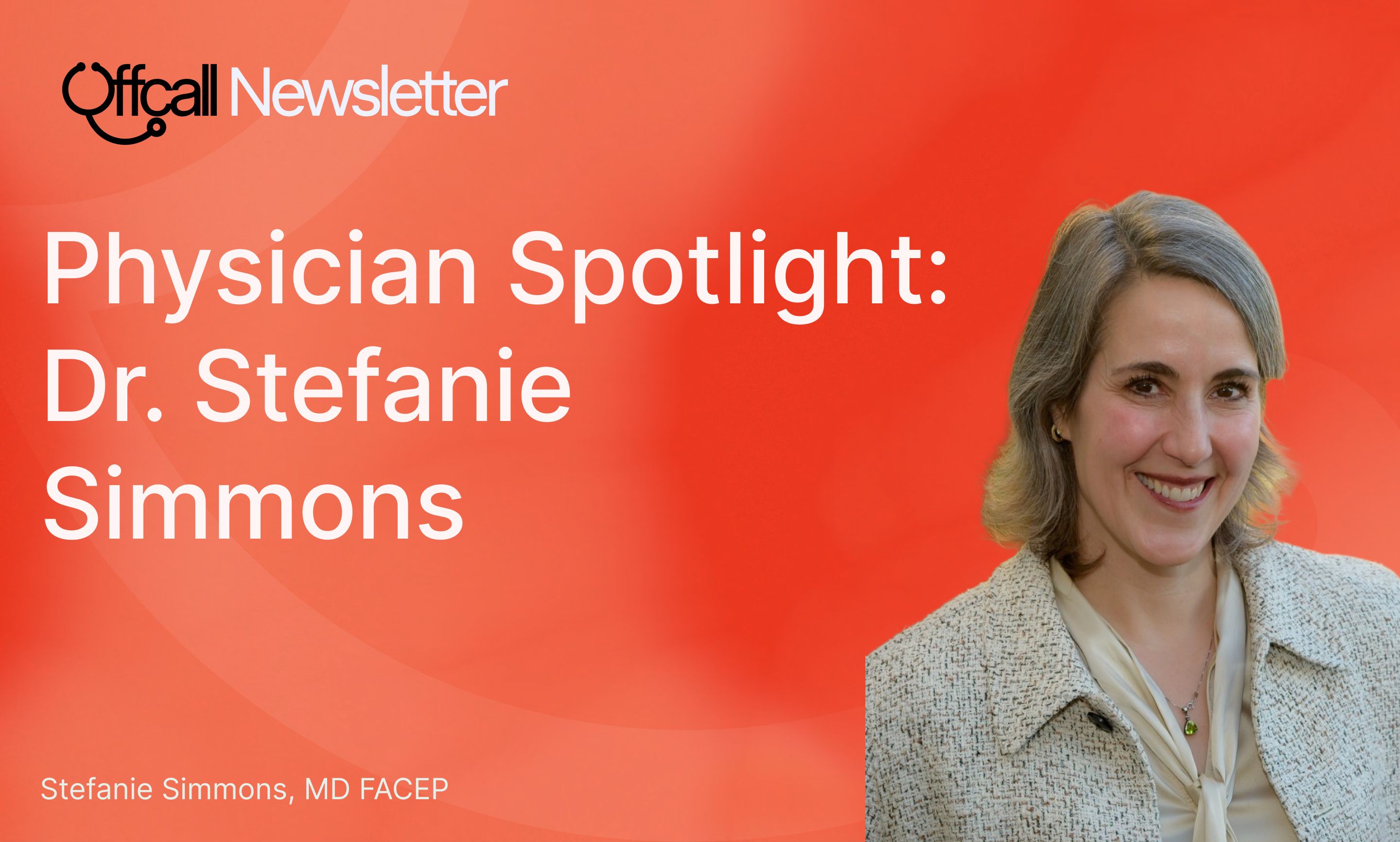
5 Questions With Dr. Stefanie Simmons, the Chief Medical Officer of the Dr. Lorna Breen Heroes' Foundation (tagged by last week’s spotlight Dr. Lara Zibners)
1. Stefanie, what would you tell a first-year resident that no one told you — but should have? Get your support systems in place! You are likely getting your first real paycheck. Make sure you are maxing out your 401k, and use some of your income to buy back some time. Hire a house cleaning service. Prep food in nice containers on your day off to ensure good nutrition. Buy some nice blackout curtains. I had two kids during residency, so even with two incomes, things were tight...but we could still do these things, and it made a HUGE difference once we started.
2. What’s the hardest part about being a physician that you think should be talked about more openly? The balance of control and responsibility. As a physician, you have a tremendous amount of responsibility and very little control. One way to think about this is through the spheres of influence. You control a small sphere in the middle, which mostly represents your thoughts and actions. A larger sphere around that is what you can influence: the performance of your team, the atmosphere of the department, and your hospital operations, for example. The largest sphere is things outside of your control that you need to accept. For physicians, we are responsible for the things we can control, must influence, and are sometimes held accountable for things outside our control, such as through malpractice litigation. Most people, physicians included, overestimate what they can control and underestimate what they can influence. We struggle to accept that some things, like patient deaths, are unavoidable. We must internalize this clearly because many outside influences don't understand our work or where we can and should make an impact.
3. What’s the thing that you love most about The Pitt and feel that it captures best about medicine? I love how the Pitt is showing the interpersonal sequelae of chronic and acute stress. It is really easy to engage with the competency (medical skill and leadership) presented in the first season. Now, in the second season, we are seeing some of the real mental health and relationship fallout from that chronic and acute stress. While watching this season with my family, my husband said, "ER people should do tours." It was an interesting idea and highlighted the need for real rest and recovery from chronic stress.
4. What’s a health hack/routine you do that could benefit other doctors or your patients? Meal prepping is my health hack, and this is also one of the best personal uses I've found for AI. I need three meals, with 12 servings each that freeze well. I specify high fiber, high protein and low saturated fat, and I mention the foods I DO NOT want to eat because of allergies or preferences. Once I have the recipes, I ask for a global shopping list for all three, and a prep schedule that allows me to cook and store all 36 servings in 2 1/2 hours. I do this once every 2 weeks and it makes healthy eating much easier (and cheaper, too)!
5. What is something you are currently working on that you hope will have a big impact on the practice of medicine? At the Dr. Lorna Breen Heroes' Foundation, where I serve as the chief medical officer, we are working with state licensing boards and organizational credentialing committees to remove stigmatizing and invasive language about mental health care from their applications. Healthcare workers report that loss of privacy and job concerns are major reasons they hesitate to seek care; this landscape is rapidly changing. For instance, 43 state medical boards no longer ask questions about mental health care and over 2000 organizations have removed these questions from their credentialing applications and peer reference forms. We are working toward a world where seeking mental healthcare is universally viewed as a sign of strength. If you want to check if your organization or state has made the change, visit: https://drlornabreen.org/removebarriers/
And finally, who do you want to nominate next to get the next Physician Spotlight? I nominate Dr. Daniel Saddawi Konefka. He is doing amazing work in mental health access for physicians and I'd love to hear his thoughts on some of these.
Have a response for Dr. Simmons? Reply to this post directly, she'll personally read every message. Also, let us know who we should feature next by replying directly to this post!
3 Things to Read This Week
Changes in Clinician Time Expenditure and Visit Quantity With Adoption of Artificial Intelligence–Powered Scribes (JAMA)
From Lisa Rotenstein, A. Jay Holmgren, Robert Thombley and many others: “Across five academic health systems and >8500 clinicians, we find that AI scribe adoption was associated with modest decreases in documentation time (16 minutes per 8 scheduled patient hours) and total EHR time (13 minutes per 8 scheduled patient hours) as well as increases in visit volume (0.5 visits per week) and E/M revenue ($167 per week).”
Sex Differences in Physician Attrition from Clinical Practice Across Specialties (Springer Nature)
From Cameron Gettel, Lisa Rotenstein, Hugo He, Jim Dziura, Yusuke Tsugawa, Arjun Venkatesh, and Ted Melnick: “Across specialties, we found a consistent pattern: Male physicians tend to exit clinical practice later, with a peak in their early 60s, whereas female physicians show an earlier and more spread-out/bimodal exit pattern, with more leaving in their 30s-40s”
Primary Care Physician Trends in the U.S. and 9 Comparator Countries (Health Affairs)
From Viktoria Steinbeck, Ishani Ganguli, and Irene Papanicolas: “By 2022, the US had one of the highest shares of primary care physicians reporting burnout (44%). Switzerland (18 percent) and the Netherlands (12%) had the lowest shares reporting burnout, alongside higher shares with satisfaction and lower shares with stress.”
Highlights From Our Community
Each week, we celebrate career milestones, launches, & other goings-on in the physician community. Have something to promote? Reply and we’ll feature you.
🙌 Thank you, Chukwuma Onyeije
Dr. Chukwuma Onyeije wrote a powerful essay about our broken referral system, citing Offcall’s new referral product as a possible solution. “Nobody lost your fax. The system was designed to lose it. Referral failures are not clerical accidents. They are the predictable result of clinical infrastructure built for a different era.” Thank you, Chukwuma! Read it here.
✅ Great career advice, Resa Lewiss
Dr. Resa Lewiss shared her advice for what to do if you work with someone who dismisses allegations of unprofessional workplace behaviors. Read more here.
🎉 Congratulations Yair Saperstein and team Avo!
Clinical AI platform Avo announced their $10M Series A financing this week – congratulations Dr. Yair Saperstein and to the Avo team. Read more here.
🎙️ Great listen, Jesse Pines
Dr. Jesse Pines announced episode 2 of his podcast Healthcare AI Pioneers with guests Lisa Stump and Robbie Freeman from Mount Sinai Health System to discuss their AI strategy and successes. Give it a listen here.
✅ Thanks for sharing, Cliff James
Dr. Cliff James shared a powerful post comparing lawyers and doctors, and about how doctors have lost control over medicine while lawyers have done the exact opposite. Thought provoking! Read it here.
📖 Great read, Ashish Jha
Dr. Ashish Jha and Dr. Tom Tsai wrote an essay entitled “Doctors should be paid to keep patients healthy about why value-based care works when physicians lead and take real accountability. Give it a read here.
🎉 Congratulations, Sofia Katz (h/t Dr. Carolyn D'Ambrosio)
Sofia Katz announced that she will be attending Duke School of Medicine this to pursue her M.D. Congratulate her here!
Did Someone Share On/Offcall With You?
Thanks for reading. Each week, we bring the latest news, information, financial and career tips, and dose of inspiration to your inbox. Our community is growing fast! Join us by subscribing to this newsletter. And please be sure to forward this newsletter to your colleagues and friends. Thank you!
Subscribe