- On/Offcall
- Posts
- On/Offcall: Introducing Offcall Referrals, Our New Private Clinician Referral Tool and Network
On/Offcall: Introducing Offcall Referrals, Our New Private Clinician Referral Tool and Network

Welcome back to On/Offcall!
🚨It’s time to fix referrals in healthcare!
This week, we announced the private beta for Offcall’s new referral tool and network for and by clinicians, starting in our first market of Columbus. We’ll be rolling out city by city in the months to come!
After spending months listening to primary care and specialist practices across the country, we heard the same thing over and over: Referrals are slow. They’re fragmented. And they’re still stuck in 1985 workflows that don’t work for us or our patients. So we built a solution to:
👉 Find the right specialist by specialty, procedure, or location in seconds
👉 Send and receive referrals in one tap. No more fax numbers or phone tag
👉 Track the status of your referrals in real-time
👉 Reach clinicians in your community instantly with HIPAA-compliant 1:1 and group messaging
👉 Simplify referral workflows for your coordinators, staff, and entire team
We can’t agree on much in healthcare, but if there’s one thing we can align on as physicians, it’s this: Referrals are broken, everywhere and for everyone.
Dr. Graham Walker and Dr. Basil Kahwash wrote a Fixing Referrals open letter, and we’d if you can add your name as a supporter (thanks to everyone who signed thus far!). If you’re in Columbus, you download the app and start using it today!
Know someone who would benefit from joining us? Help us grow our tent by forwarding this newsletter to your physician colleagues and subscribing here.
How Sevaro Is Transforming Rural Stroke Care, With Dr. Raj Narula and Dr. Melanie Winningham
This week, we welcomed Dr. Rajiv Narula and Dr. Melanie J. Winningham to How I Doctor! As a vascular neurologist and Founder and CEO of Sevaro, Dr. Narula set out to solve the alarming access issues in stroke care. It’s a simple idea: Where you live should not be the biggest predictor of whether you walk out of the hospital after a stroke. Alongside Dr. Winningham, a stroke specialist and VP of Clinical Strategy, Dr. Narula and his team built a solution that can actually achieve this.
They join Graham to break down Sevaro’s solution and what it will take to actually fix stroke care now and in the future:
👉 How eliminating the “middleman” (call centers, paging, admin layers) has been the key to Sevaro making stroke care actually work
👉 What it looks like to get a board-certified neurologist on screen virtually, in under 45 seconds, and why that changes everything
👉 How AI should support clinical decision-making, not replace it, by anticipating what physicians need
👉 Why the neurology workforce gap is getting squeezed and how virtual care is becoming a real solution
👉 The single regulatory change that could unlock access to specialty care for millions overnight
❤️ Thanks Dr. Narula and Dr. Winningham for building the system for and by physicians that patients need.
See the Highlights From This Week’s AI Webinar!
We're still buzzing from this week’s AI webinar, where we had 550 physicians, over 200 comments, and a highly engaged audience led by Graham, Dr. Michael Hobbs and special guest Rishma Jivan.
The session was all about practical, real-world AI use cases, understanding failure modes, and giving you a simple framework to evaluate AI tools. One moment that stuck with us? The CRAFT Check: a simple, powerful 30-second quality gate before you trust any AI output. A big thank you to our partners Evidently and MD+ for supporting this work! 🙌
See the slides from the session here and you can also watch a replay here.
Physician Spotlight: Dr. Joseph Shapiro
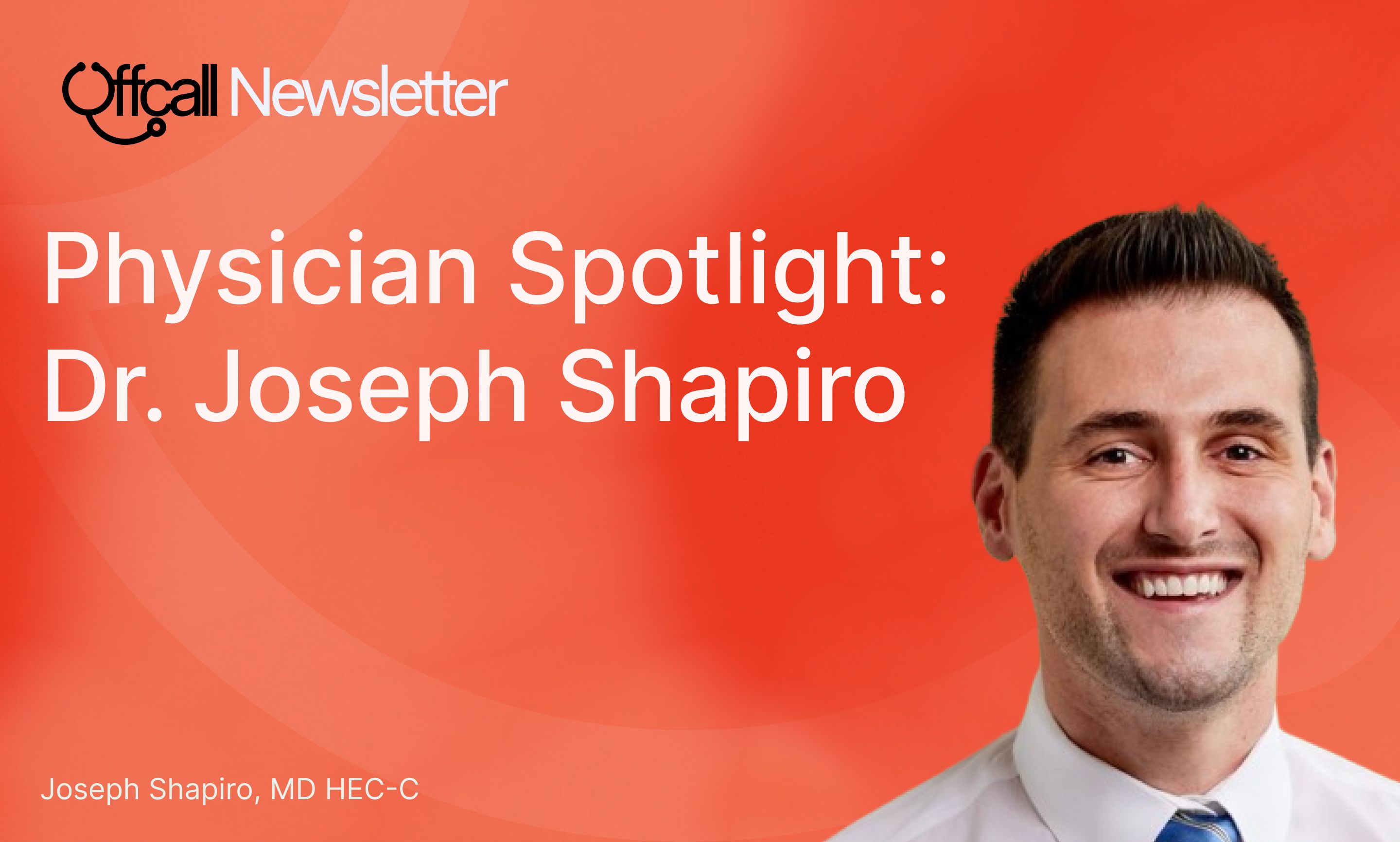
6 questions with Dr. Joseph Shapiro, pediatric emergency medicine physician and clinical ethicist at Children’s National Hospital in Washington, D.C.
1. Joseph, what do you think the public most misunderstands about being a physician in 2026? Getting good healthcare and being healthy has become harder for many people, and they see a parade of economic actors — hospital systems, insurers, drug companies — that seem to be making money off them. There's a natural inclination to lump doctors into that group. But most physicians make significant personal sacrifices to care for patients. We're on their side more than not.
2. Forget pizza parties — what's one way you've coped with burnout that's actually made a difference? Diversification. You have to find ways to be a doctor without spending all day in front of the EMR. For me, that has meant building an academic career — writing, teaching, and ethics consulting.
3. What's the hardest part about being a physician that you think should be talked about more openly? For the ER, it's a white-collar job that is hard on your body. I'm not sure people realize how physically demanding ER work can be with the schedule flipping and late nights. ER physicians don't work 40-hour weeks because we can't. It's more like the NFL — play once a week, then recover — than the MLB, where there's a game almost every day.
4. ChatGPT launched Health — will this be good or bad for doctors? As someone who works in clinical ethics, I think the "good or bad" framing is a little beside the point. AI tools are coming to healthcare. There are compelling business cases at the organizational and consumer levels; even if adoption is slow, we will all see AI in our workplaces relatively soon. The question is whether we're building tools with the right guardrails. There are real concerns about accountability, transparency, access, and the preservation of the doctor-patient relationship that need to be addressed. None of these problems is unsolvable, but active clinicians need to be at the table now to shape how these tools are designed, deployed, and regulated. If we are slow to get involved, the decisions will get made without us.
5. What's one under-the-radar AI tool that has made the most impact on your practice and why? Elicit, for literature reviews and evidence-based medicine. It's far more intuitive and accurate than a traditional PubMed search. Academia can be slow to adapt, but I expect MeSH searches to go the way of library card catalogs in the coming decade.
6. What is one thing you wish your patients would ask you more? "What would you do if this were your child?” Shared decision-making can get complicated. There's confusion, sometimes mistrust. It's hard to communicate risk effectively or tailor recommendations to a family's individual values. But when a family asks what I would do for my own child, it strips away all of that. It forces honesty and trust on both sides. They understand I might not be right — but they know I'm giving them the best advice I have to offer.
Finally, who do you want to nominate for the next Physician Spotlight?? Ioannis Koutroulis, who is the Dean of Admissions at GWU (the most applied to medical school in the country) and has done strong academic work around AI and sepsis.
Know someone else who should be featured? Reply or tag them and their company in the comments!
3 Things to Read This Week
Health Systems Govern Only the Tip of the AI Iceberg (NEJM)
New editorial citing Offcall’s 2025 Physicians AI report: Here’s why health systems need to reform their approach to AI governance. From Dr. Erkin Otles, Dr. Sara Murray, Dr. Ashley Beecy, Dr. Alexander Khalessi, and Dr. Karandeep Singh.
Mediating Factors and Well-Being Differences by Gender Among Academic Physicians (JAMA Network)
What factors account for differences in occupational well-being between female and male physicians at academic medical centers? From Dr. Miriam Stewart, Dr. Mariah Quinn, and Mihriye Mete.
Best and Worst States for Doctors (WalletHub)
To assist doctors in choosing where to practice, WalletHub compared all 50 states and the District of Columbia using 19 key metrics.
Highlights From Our Community
Each week, we celebrate career milestones, launches, & other goings-on in the physician community. Have something to promote? Reply and we’ll feature you.
🎉 More Match Day highlights, congratulations to all!
A round up of more Match wins! Elsie Agbo, Mehariw Netsere, Adam Skura, (h/t Sam Skura), Korak Chakraborti, Andres Inzunza, Jerome Arceneaux, Nikhita Perry, Courtney Oei, Win Mar Lar Kyin, Kylie Long, Alexis Dickerson, Wassim Najjar, Bhavana Kunisetty, Johna Joseph Jr., Rohit Mantena. Feel free to also tag someone else who should be recognized in the comments! Also see some this year’s key Match Day trends and data here.
⚕️Check out his new substack, Vivek Murthy
Dr. Vivek Murthy announced Staying Human, a Substack exploring how to build a life with more connection, joy, and fulfillment. Check it out here.
🎥 Watch her video, Alexis Dunne
Menopause specialist Dr. Alexis Dunne posted a provocative video about being a doctor in the U.S. in the traditional compensation model. Watch it here.
🩺 Interesting commentary, Nkem Ezeamama
Dr. Nkem Ezeamama posted an essay about why most physicians retire with less wealth than people who earned half their salary – not because they didn't work hard enough but because nobody taught them the difference between income and wealth. Read more here.
🎉 Congratulations Ahmed Kayssi
Dr. Ahmed Kayssi started a new position as Head of Division of Vascular Surgery at Sunnybrook Health Sciences Center! Congratulate him here!
Did Someone Share On/Offcall With You?
Thanks for reading. Each week, we bring the latest news, information, financial and career tips, and dose of inspiration to your inbox. Our community is growing fast! Join us by subscribing to this newsletter. And please be sure to forward this newsletter to your colleagues and friends. Thank you!
Subscribe